Pixel Oracle · Nonogram
15×15 Nonogram Overlap: Find Guaranteed Cells Without Guessing
Learn the 15×15 Nonogram overlap method with exact single-run and multi-run examples. Find guaranteed cells, manage slack and keep every move logical and safe.
Quick summary
The 15×15 Nonogram overlap method compares every legal placement of a clue run and fills only cells covered in all of them. For a single run of 10 in a clear 15-cell line, the six legal starts share cells 6–10; multi-run clues require separate run identities and a full candidate-consensus check.
What 15×15 Nonogram overlap actually proves
A Nonogram clue describes ordered blocks of filled cells. Each block has the stated length, and consecutive blocks are separated by at least one empty cell. The aim is to mark only facts forced by the row and column clues.
Overlap does not ask where a run probably sits. It generates the run's legal positions inside the current line and keeps cells that have the same state in every possibility. If every legal placement fills one cell, that cell is guaranteed even though the run's exact start remains unknown.
Two safeguards matter before any cell is filled:
- Every placement must respect the full clue order, mandatory gaps and confirmed fills or X marks.
- Either the same clue block covers the cell in every placement, or the complete set of legal line patterns agrees that it is filled.
Single-run example: clue 10 in a 15-cell line
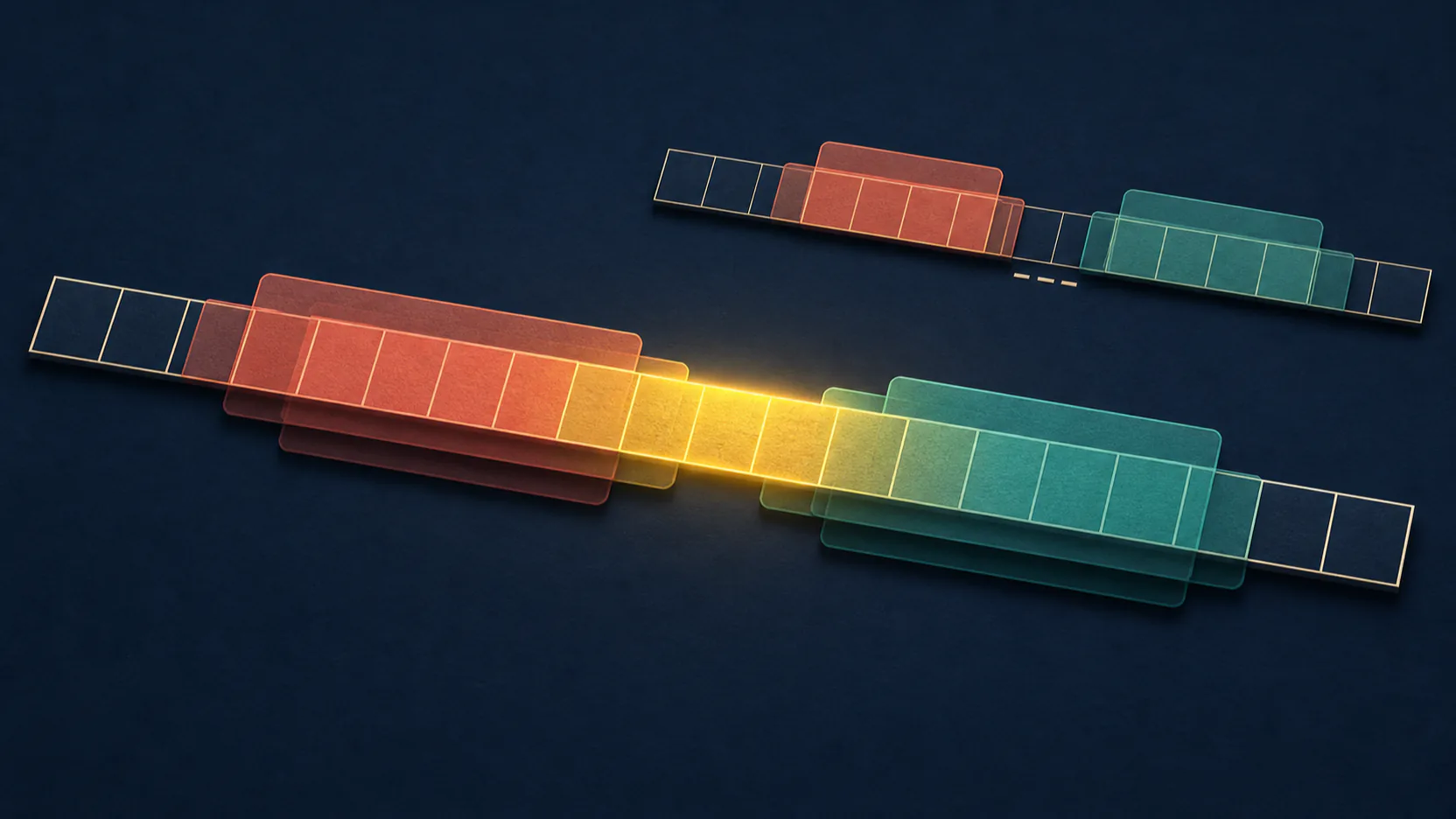
Take an empty 15-cell row with the single clue 10. The run can start in positions 1 through 6. Compare the earliest and latest placements:
Earliest  ██████████·····
Latest    ·····██████████
Certain   ·····█████·····
Position  1 2 3 4 5 6 7 8 9 10 11 12 13 14 15
Cells 6–10 are filled in both extremes and in all four placements between them. Those five cells are safe to fill. A dot in the diagram means ‘not proved by this comparison’, not a confirmed X.
For a single run of length k in a clear line of length n, the overlap count is max(0, 2k − n). Here, 2 × 10 − 15 = 5. A clue 8 fixes one central cell in an empty 15-cell line, while clue 7 has no overlap before crossing information reduces its available interval.
This shortcut is valid only for one run inside a known interval. Multi-run clues and lines with existing marks need the full placement rules.
Multi-run example: why clue 4 8 needs more care
Now consider the clue 4 8 in 15 empty cells. The blocks require 4 + 8 filled cells plus at least one separating empty cell, so their minimum footprint is 13. Only two cells of slack remain.
Earliest  ████·████████··
Latest    ··████·████████
Certain   ··██···██████··
There are six legal patterns. Comparing all of them shows that the first run always covers cells 3–4 and the second always covers cells 8–13. Those eight cells are guaranteed.
Cell 6 is the trap. It is filled in both outer drawings, but the earliest placement assigns it to the eight-run and the latest assigns it to the four-run. Another legal placement leaves cell 6 empty. Overlaying only the two extremes would therefore create a false fill.
The safe form of overlap either compares each labelled run with itself or, more generally, enumerates every legal line pattern and keeps only full consensus. Pixel Oracle's line solver uses the second form: it generates ordered patterns, rejects candidates that conflict with known cells, then returns a forced state only when every remaining pattern agrees.
Re-run overlap after X marks shrink the interval
Overlap becomes stronger as crossing lines provide boundaries. Suppose a row has one clue 6, and cells 1–3 plus 12–15 are confirmed empty. The run is confined to cells 4–11, an eight-cell interval. Its legal starts are 4, 5 and 6, so cells 6–9 are filled in every placement.
This is the same calculation on a smaller legal interval, not a new rule. With multiple clues, first prove which run belongs inside the interval. An X may separate two blocks, but it does not let you assign a block arbitrarily.
After adding each guaranteed fill or X:
- Re-evaluate the same line against all its clues.
- Inspect the perpendicular line through the new fact.
- Close a completed run with X marks when its boundary is proved.
- Return to any line whose legal interval has become smaller.
A no-guess workflow for larger grids
A 15×15 grid contains more candidate space than a 5×5 or 10×10 puzzle, but the decision loop stays local:
- Scan constrained lines. Start with long single clues or multi-run clues whose blocks and gaps nearly fill the available space.
- Generate legal placements. Respect clue order, known fills and X marks.
- Keep consensus cells. Fill or mark only states shared by every legal placement.
- Propagate crossings. Every certain cell changes one row and one column.
- Close completed runs. Add proved empty boundaries so later scans use smaller intervals.
- Rescan rather than guess. If overlap yields nothing, try another logical rule or request a logic-only hint.
The original WebPBN pbnsolve documentation describes left- and right-packed line reasoning and explicitly notes that this simplified overlap is not a complete line solver. That boundary matters: overlap is a sound source of local facts, but it may not finish every valid puzzle by itself.
Pixel Oracle separately checks that each admitted published puzzle has one solution and that a deterministic logic proof can be replayed. A unique solution alone does not prove that this one line technique will always make progress, and these synthetic lines are not proof for any Daily puzzle.
Use the no-guess standard for that distinction, or combine overlap with the broader Nonogram strategy workflow.
Frequently asked questions
What is overlap in a 15×15 Nonogram?
It is the set of cells covered by the same clue run in every legal placement, or whose filled state is shared by every complete legal line pattern. Those cells are guaranteed even before the run's exact position is known.
Which single clues overlap on an empty 15-cell line?
Runs of 8 or more. A run of 8 fixes one central cell, while a run of 10 fixes five. For a single run of length k, the overlap is 2k − 15 when that value is positive.
Does a unique Nonogram solution mean guessing is never needed?
No. Uniqueness is a whole-puzzle property; it does not show that a particular deduction method can always advance. A separate replayable logic trace is needed to support a no-guess claim.
Use consensus, then cross-check
The safest 15×15 Nonogram overlap method is candidate consensus, not visual intuition. Slide a single run through every legal start, keep only the shared cells and repeat the check whenever X marks shrink its interval. For multiple clues, preserve block identity and test all legal patterns so a cell covered by different runs in two extremes is not mistaken for a guarantee. Then carry each proved cell across the grid and let the next line do the work.